
The Parts of a Drumkit explained for beginners
The Parts of a Drumkit explained – Structure, Function, and Explanation for Beginners
The Components of a Drumkit – Structure, Function, and Explanation for Beginners
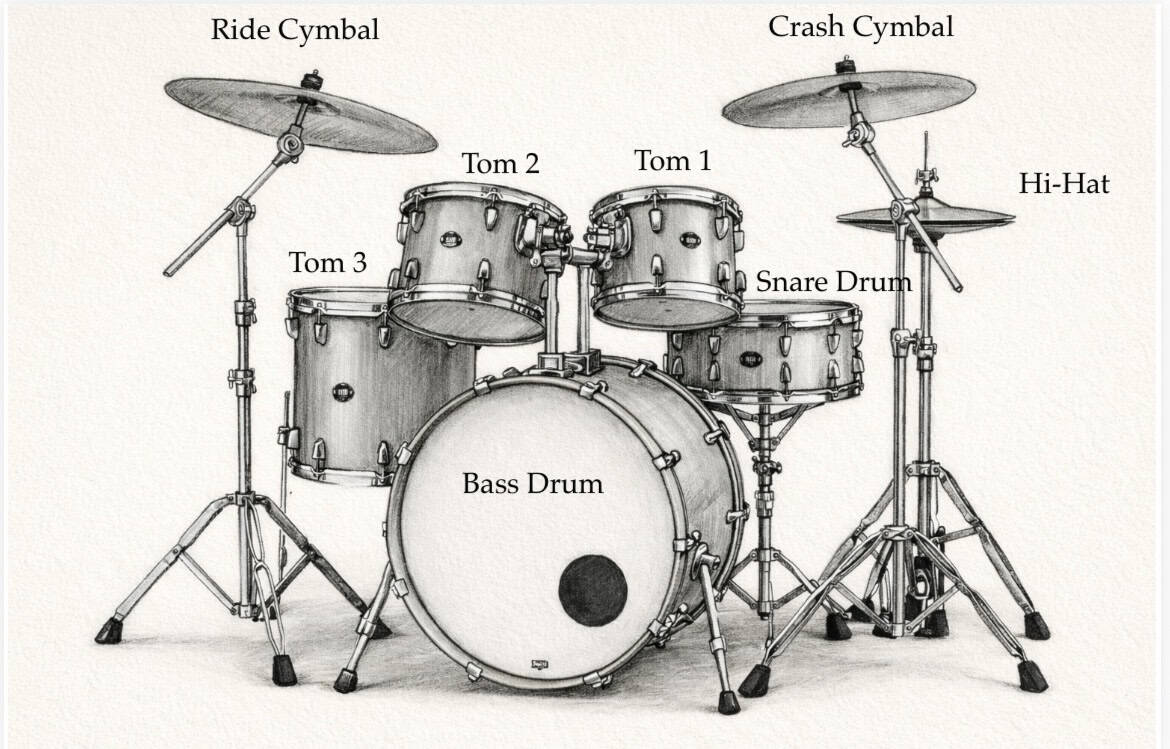
A drumkit consists of several drums and cymbals that together form a complete rhythmic system. Those who want to learn to play the drums will become familiar with and understand the individual components in their first lessons, as well as their function within the drumset. In this blog post, I’ll clearly explain the structure of a drumset – ideal for beginners.
The individual Drums of the Drumkit
1. Snare Drum
The snare drum is the heart of the drumset. The characteristic snare drum sound is created by the snare wires (fine metal wires that are shaped like coils) stretched across the bottom head (resonant head) of the drum. In pop/rock music, the Snare Drum is typically played on beats 2 and 4 in 4/4 time. This is also known as the backbeat. The snare drum shell can be made of various materials, such as wood (maple, birch) or metal (copper, brass, aluminum).
2. Bass Drum (or Kickdrum)
The bass drum is the largest drum of the drumset. It sits on the floor and is played with the bass drum pedal. Its deep, powerful sound forms the foundation of many rhythms. There are also double pedals that allow the bass drum to be played with both feet. The bass drum is usually dampened internally with pillows or blankets, as a very short sound is often preferred with this drum. The resonant head often has a hole for a microphone. The shell is made of wood such as maple, birch, mahogany, poplar, oak, or bubinga.
3. Toms (Tom-Toms)
A standard drumkit usually has two or three toms of different sizes (from 8 to 18 inches in diameter). However, larger drum kits with significantly more toms also exist. The different sizes and tunings of the drums add a melodic component to the overall drum sound. A distinction is made between rack toms (mounted on top of the bass drum or suspended on stands) and floor toms (which stand on legs on the floor). Like the bass drum, the shells are made from various types of wood: maple, birch, mahogany, beech, poplar, oak, or bubinga.
The Cymbals
The cymbals of a drum kit are so-called idiophones (self-sounding instruments). This means the sound is produced by the vibration of their entire solid body. Cymbals are primarily made of copper-tin alloys. The designation B20 bronze indicates that the material is 80% copper and 20% tin. There is also B8 bronze (92% copper, 8% tin), as well as cymbals made of brass. Cymbals come in a wide variety of sizes – from 7 inches to 24 inches in diameter. Furthermore, there are very thin and very thick cymbals. The sound of cymbals can therefore vary dramatically.
4. Hi-Hat
The hi-hat consists of two cymbals mounted on a hi-hat stand and can be opened and closed with a pedal. It can therefore be played with the foot via the pedal and simultaneously with drumsticks. The hi-hat is a very dynamic instrument and can significantly influence the sound and timing of rhythms. The standard diameter of hi-hat cymbals is 14 inches. However, some drummers prefer 13- or 15-inch hi-hats.
5. Crash-Cymbal
The crash cymbal is very often used for accents in music – for example, when a new section of a song begins. A crash cymbal often follows the end of a drum fill or solo. The size and number of crash cymbals can vary considerably.
6. Ride-Cymbal
The ride cymbal is frequently used in pop/rock music as an alternative sound to the hi-hat. In traditional jazz (swing), the ride cymbal has a particularly important function. In this style, the ride cymbal, along with the bass, provides the foundation of timekeeping. In this style of music the snare drum and bass drum often only have an accompanying role.
Other components of the Drumkit
Besides drums and cymbals, the following elements are also part of the setup of a drum kit:
- Drumkit-Hardware (tripods, pedals, mounts, Drumracks)
- Drum Throne – It can be adjusted in height – this is very important to enable an optimal seating position tailored to one’s own body size!
- Drumsticks – Drumsticks come in different sizes – most are made of wood (hickory, oak, maple) – but there are also sticks made of metal or carbon fiber. Thicker, heavier drumsticks are usually used for louder music.
- Drumheads (Batter and resonant heads) – There are many different drumheads, which significantly influence the sound of the drums. The type of music and personal taste play a major role in the choice of drumheads. Most heads are made of plastic (Mylar). There are also coated heads (warmer sound) and pre-dampened heads (with an integrated damping ring), as well as single- or double-ply heads. The choice of drumhead has a greater influence on the sound than the shell material.
- Drumrug: To prevent the bass drum and hi-hat from slipping (and also to avoid ruining the stage or rehearsal room floor), a drumrug is used on which the drum kit is set up.
Difference: Acoustic Drumkit vs. E-Drumkit
An electronic drumset (e-drumkit) consists of pads (either completely made of plastic or with mesh heads – which are plastic nets that simulate the function of a drumhead) instead of traditional acoustic drums. The sound is generated digitally by a drum module. An e-drumkit is particularly well-suited for quiet practice at home. For a realistic playing feel, I recommend an e-drum kit with mesh heads.
Conclusion
A drumkit can be set up in many different ways. But almost every drumkit consists of the drums and cymbals mentioned above. The sound is significantly influenced by the size (diameter, depth) and shell material of the drums, the choice of drumheads, and the tuning of the drums. Ultimately, the music and personal taste always determine which drumset configuration is chosen.

About the author:
Mag.art. Florian Stöger
- IGP – Jazz drums/percussion instrumental studies at the university of music and performing arts in Vienna. Jazz drum lessons with Manfred Krenmair, Prof. Fritz Ozmec and Prof. Mario Lackner, classical percussion lessons with Prof. Oliver Madas.
- Guest Student at the Musicians Institute in Los Angeles/Hollywood.
- Private lessons and Masterclasses with: Thomas Lang, Jojo Mayer, Bernard Galane, Dave Elitch, Gorden Campbell.
- Many years of teaching expierience: Drum teacher at the Musik- und Kunstschule Waidhofen an der Ybbs, VHS Heiligenstadt and Borg Krems an der Donau. Since 2020 Drum I am the drum teacher at Borg St. Pölten.
- Many concerts with Coverbands und songwriters different musical styles.
- Teacher at the Vienna Drum School
- Author of the Book: “Drum Solo Book for Beginners”
Check out my Drum Solo Book:
Follow me on Youtube:
Follow me on Instagram:


